By Chet Dalzell, Digital Advertising Alliance
Performance marketing is entering the AI era here in the United States very fast.
A new U.S. research report sees brands and their agencies adopting artificial intelligence (AI)-driven processes and techniques at rapid levels to drive performance-oriented aims in marketing — and achieving significant boosts in customer acquisition, incremental sales and retail traffic as a result.
“AI is both disruptive and constructive,” said Jonathan Margulies, managing partner, Winterberry Group, and report author. “What is certain is the speed of AI adoption by brands, and how they are leveraging data and technology to spur AI-enabled and measured performance marketing functions.”
The report from Winterberry Group, a strategic consulting firm, is titled “Delivering Performance in the Era of AI: Technology, Data and New Opportunities to Unlock Omnichannel Success.” The third in the “Delivering Performance” research series—which aims to track how U.S. brands are engaging with an array of media channels to support their bottom-line business needs—the report’s findings are based on a survey of more than 250 U.S. advertising and marketing professionals, supplemented by in-depth industry leader interviews.
Leveraging the Performance Marketing ‘Core Four,’ Plus One
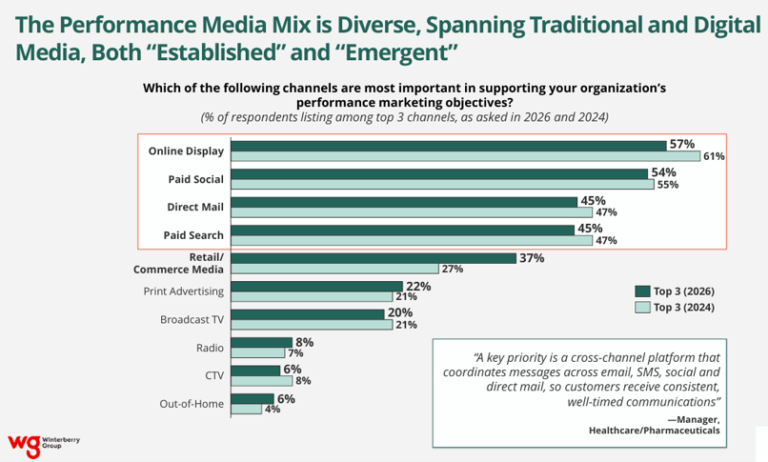
More than seven in ten survey panelists say they have increased their spending on performance-oriented marketing in the past three years – uniformly across various vertical segments, among them financial services, business-to-business technology, consumer packaged goods and retail. Of the “core four,” online display advertising was ranked among the top three channels deployed (57%), followed by paid social (54%), direct mail (45%) and paid search (45%). Retail media networks also were cited by 37%, up from 27%, in a similar survey a year ago.
“As AI has caused disruption in search, social media and content discovery, marketers seem to be relying more on ‘value-on’ channels that deliver tangible, credible forms of engagement,” said Margulies, noting that direct mail serves to boost digital media performance when deployed in conjunction.
AI-Enabled Benefits in Direct Mail—and Wider AI Deployment in Support of Performance Marketing
The research focuses specific attention on the use of AI in support of direct mail programs, noting the significant gains the technology is driving across a range of direct mail performance metrics; marketer panelists cited improved targeting accuracy (42.5%); improved return on investment (41.6%); better orchestration with other marketing channels (34.2%); and improved efficiency in production, postage and operational costs (33.3%) as specific benefits of their recent AI-centered initiatives. Direct mail spending in the United States is expected to increase by 1.1% in 2026 to $36.6 billion.
“At the same time,” Margulies said, “brands are adopting AI data-enabled techniques in the strategic planning, targeting, reporting and analysis to increase marketing and media effectiveness across all channels. The goal is to achieve greater omnichannel marketing prowess—understanding the contributions and performance metric of each marketing effort, working in concert with others.”
AI Benefits in Performance Marketing are Palpable – and Accumulating
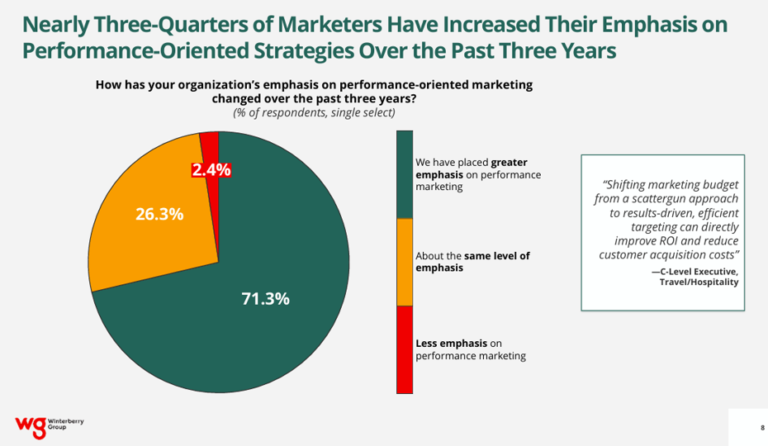
PERFORMANCE-ORIENTED STRATEGIES GAINING IMPORTANCE | During the past three years, nearly three-fourths of marketers have increased their emphasis on performance marketing strategies – with less than 3% decreasing such emphasis. The need to be less scatter-shot with marketing spend – and invest in what works is driving this trend.
INSIDE DIRECT MAIL | 83% of panelists said they plan to growth their 2026 direct mail budgets, responding to heightened demands to support chief performance marketing aims – customer acquisition, incremental sales and retail traffic generation. Nearly 96% of panelists said they have used AI to support direct mail performance, with 93% characterizing such investment delivering moderate or better value. Overall, more than six in ten will increase their direct mail budget in 2026 by between 1-10%, and two in ten will increase their direct mail spend by more than 10%. Its reliability as a greater ROI performer – compared to other media channels – is cited by 57% of respondents.
DIGITAL MEDIA LIFT WHEN COMBINED WITH DIRECT MAIL | Marketing organizations report better digital media performance when deployed in conjunction with direct mail, with the greatest benefits accruing to online display (49.8% of respondents), paid social (also 49.8%) and paid search (43.4%).
AI INTEGRATION POSES MODERATE OPERATIONAL CHALLENGES | While no single issue presents a principal obstacle to continued AI evolution, the most oft-cited concerns are its ability to integrate with existing systems/workflows (reported by 38%) and high implementation costs (36%).
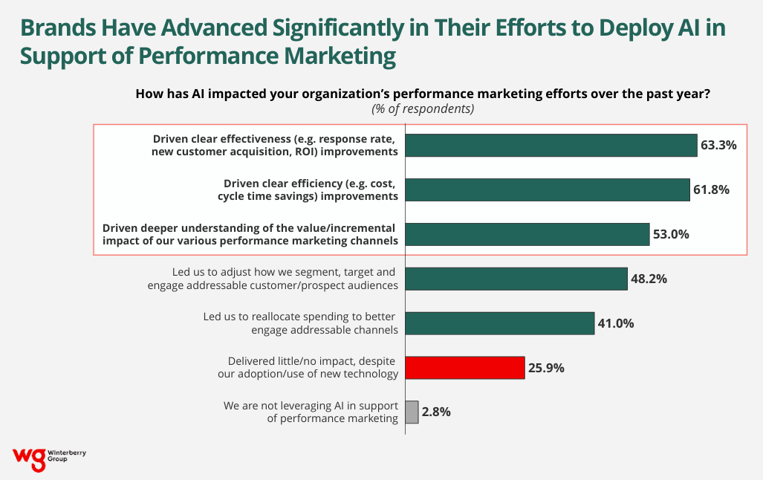
AI BENEFITS ARE QUANTIFIABLE | Just 25.9% of marketers report that their AI investments to date have had little or no effect on their performance marketing metrics. More than six in ten report gains in marketing effectiveness (response rates, customer acquisition, ROI improvement) as well as gains in efficiency (cost and cycle time savings). Fifty-three% report better understanding of the incremental impact of various marketing performance channels. Other benefits extend to adjustments to audience segmentation and targeting (48.2%) and reallocation of spend among addressable channels (41.0%).
BULLISH ON AI – TO OPTIMIZE BUSINESS OUTCOMES | Marketers see the most transformative use cases for AI in performance marketing is media planning across channels; optimizing audience management, channel selection, resourcing, timing and content personalization – without the worry of siloed data.
“The AI maturity curve is taking shape,” Margulies said. “From early investments in workflow – to content and creative optimization, audience segmentation, and predictive analytics, we are setting the stage now for AI-enabled omnichannel orchestration and attribution-driven optimization. That is not just the nirvana for performance marketers, but all chief marketing officers and brand stewards. The ability to bring data, technology, and media together is now without challenges, but by having a vision and discipline for an enterprise-class mar-tech infrastructure, marketing organizations are planning for an omnichannel performance future.”

The full research report is sponsored by United States Postal Service and NaviStone, and is available for download:
https://winterberrygroup.com/delivering-performance-in-the-era-of-ai-technology-data-and-new-opportunities-to-unlock-omnichannel-success
Related Posts
New Study: Brands Turning to AI, ‘Core Four’ Media to Achieve Performance Marketing Goals
By Chet Dalzell, Digital Advertising Alliance Nearly three in four marketers are increasing their investment…
The Next Great Intelligence Leap: What if Creative Spending in Advertising Was Just as Accountable as Audience and Media?
By Chet Dalzell, Digital Advertising Alliance Source: Creative Spend vs Creative Spend Powered by Creative…
MCNY Kicks Off Centennial Year Programming with ‘Annual Outlook’ 2026: Winterberry Group Expects 9.4-percent for U.S. Ad, Marketing and Data Spend in 2026 to Top $660B
Winterberry Group Senior Managing Partner Bruce Biegel MCNY KICKS OFF CENTENNIAL YEAR PROGRAMMING WITH ‘ANNUAL…
On Turning 100: It Starts with One…
By Chet Dalzell, 2026 MCNY President 2026 is a momentous year. The United States turns…