


By Chet Dalzell, Digital Advertising Alliance

The application of creative data by brands to create resonance and drive engagement is making huge strides this year, according to a new report from Winterberry Group, a strategic consulting firm famous for its “Annual Outlook” presentations each year with the Marketing Club of New York.

Following months of rapid data and technology investments, a large majority of U.S. and U.K. brands have adopted creative intelligence (CI) solutions and platforms in their advertising and marketing activity – with a substantial middle share deploying creative insights across prospect and customer engagements,.

The report, titled “Defining Creative Intelligence: Marketing Maturity,” is based on quantitative survey research, supplemented by qualitative interviews with industry practitioners.

Laggers to Leaders | Five Levels of CI Adoption

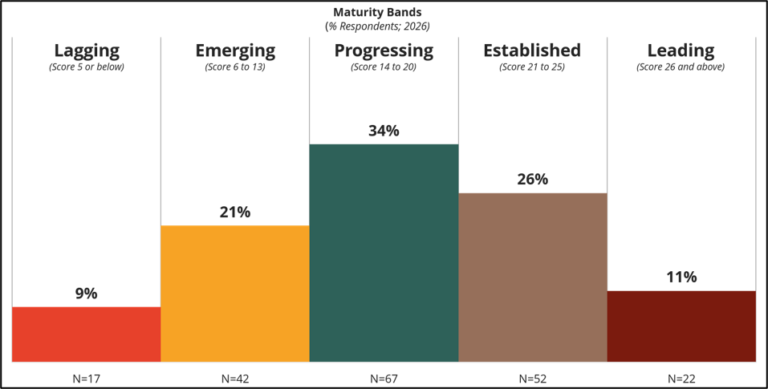
The research identifies five levels of adoption and maturity among brands – from laggards to leaders – with attributes of each, which is useful for organizational benchmarks and roadmaps, the Winterberry Group report said. Among the surveyed brands, 9 percent are lagging, 21 percent are emerging, 34 percent – the largest share – are progressing, 26 percent are established, and 11 percent are leading – with 1 percent able “to make it all the way from having an operationalized capability through to using it consistently, connecting the data and letting these signals change a creative decision.”

“Creative intelligence – using creative insights to engage prospects and customers — is nearly fully adopted,” said Bruce Biegel, executive chairman and senior managing partner, Winterberry Group, one of the primary authors of the report, the third in a series of reports spanning back two years. “The tech is there. The data is there. The insights are being identified, yet their application – driven by process and people – are still outstanding. We’re seeing a fast-growing maturity – most brands are either progressing, established, or leading – yet there is still room for growth in having CI insights fully trusted, operationalized and driving creative decisions.”

Creative Intelligence: Maturity Bands Among Brands


Maturity Band Definitions

Maturity Band

Definition

Lagging

Exploring creative intelligence but has not yet implemented any solutions or concrete tests

Emerging

Runs limited tests of creative intelligence solutions, typically in specific campaigns or use cases

Progressing

Has one or more creative intelligence solutions in place and has been using them consistently

Established

Used by cross‑functional teams and is applied to both pre‑flight and in‑flight campaign optimization

Leading

Embedded across the organization and channels, informing pre‑flight, in‑flight and post‑campaign measurement in an integrated way

Source: Creative Intelligence Maturity Bands and Definitions, “Defining Creative Intelligence Marketing Maturity,” Winterberry Group, September 2026.

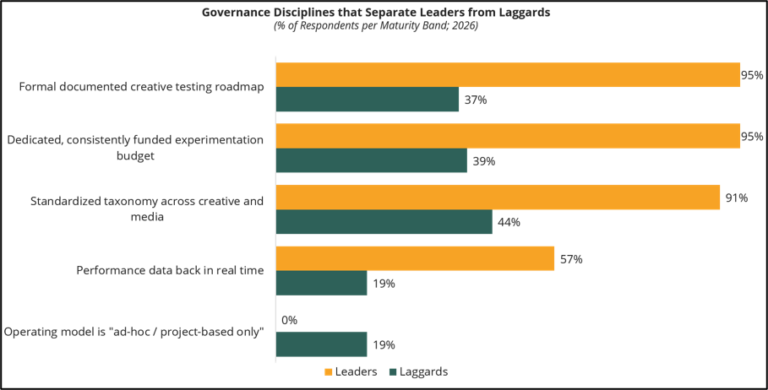
According to the report, best-in-class CI-driven organizations are differentiated in five ways:

  • A written, documented testing regimen, from which all subsequent governance markers flow;
  • A consistently funded experimentation budget to enable testing;
  • (3) 100-percent measurement and documentation of creative lift from media and targeting;
  • a single process accessed by cross-functional teams – creative, media, strategy – with a shared workflow based on CI insights; and
  • a level of ownership and flexibility among in-house strategy teams, supplemented by a specialized creative intelligence vendor rather than a generalist agency.
Source: Creative Intelligence Leaders and Laggers: Governance Discipline Differs, “Defining Creative Intelligence Marketing Maturity,” Winterberry Group, September 2026.

“What is holding back value is not a missing tool,” said Michael Harrison, CEO, Winterberry Group, “it’s the gap in having clearly defined process and workflows, a lack of operational integration and the clear need for management to take a leadership approach to optimize creative, audience and media together.”

The newest findings build on previous 2025 and 2026 Winterberry Group studies which defined creative intelligence as the ability to collect, structure and analyze creative decisions against performance data to continuously optimize assets for effectiveness and engagement, and described the pace of CI investments by brands.

Other key findings from the latest report include: 

  • TOWARD PEAK CI ADOPTION  |  91 percent of brands expect CI investments and operationalization to increase – with nearly half expecting to be among the highest level of CI maturity within two years.
  • BARRIERS TO CI APPLICATION ARE ORGANIZATIONAL  |  The main barrier to maturity is organizational rather than analytical – with the largest challenge of getting insights from one team to another, especially in creative and audience planning.
  • BROKEN RETURN PATHS  |  “Brands have built more measurement than the industry gives them credit for,” the report states. “What they have not built is the mechanism that turns a measurement output into a changed asset or a changed brief.”
  • A DISCIPLINE TO TEST  |  Fully 70 percent of brands report a formal documented testing roadmap, with a similar share having an experimentation budget.
  • SHARED WORKFLOWS FEED AUTOMATION  |  Where workflows for creative, audience and strategy connect, automated optimization and adoption rises from 45 percent to 78 percent.

For this research report, Winterberry Group surveyed approximately 200 creative and media agencies across the US and UK, complemented by in-depth interviews with marketers, agencies, and technology providers.

Winterberry Group’s “Defining Creative Intelligence Marketing Maturity,” report was made possible by Smartly, Vidmob, Adobe, VideoRunRun, Newform.ai and AppsFlyer.

The full research report is available for download: https://winterberrygroup.com/creative-intelligence-the-market-maturity-curve

Related Posts